Greece as Example for European Countries: What can we learn from Economic Crisis in Greece?
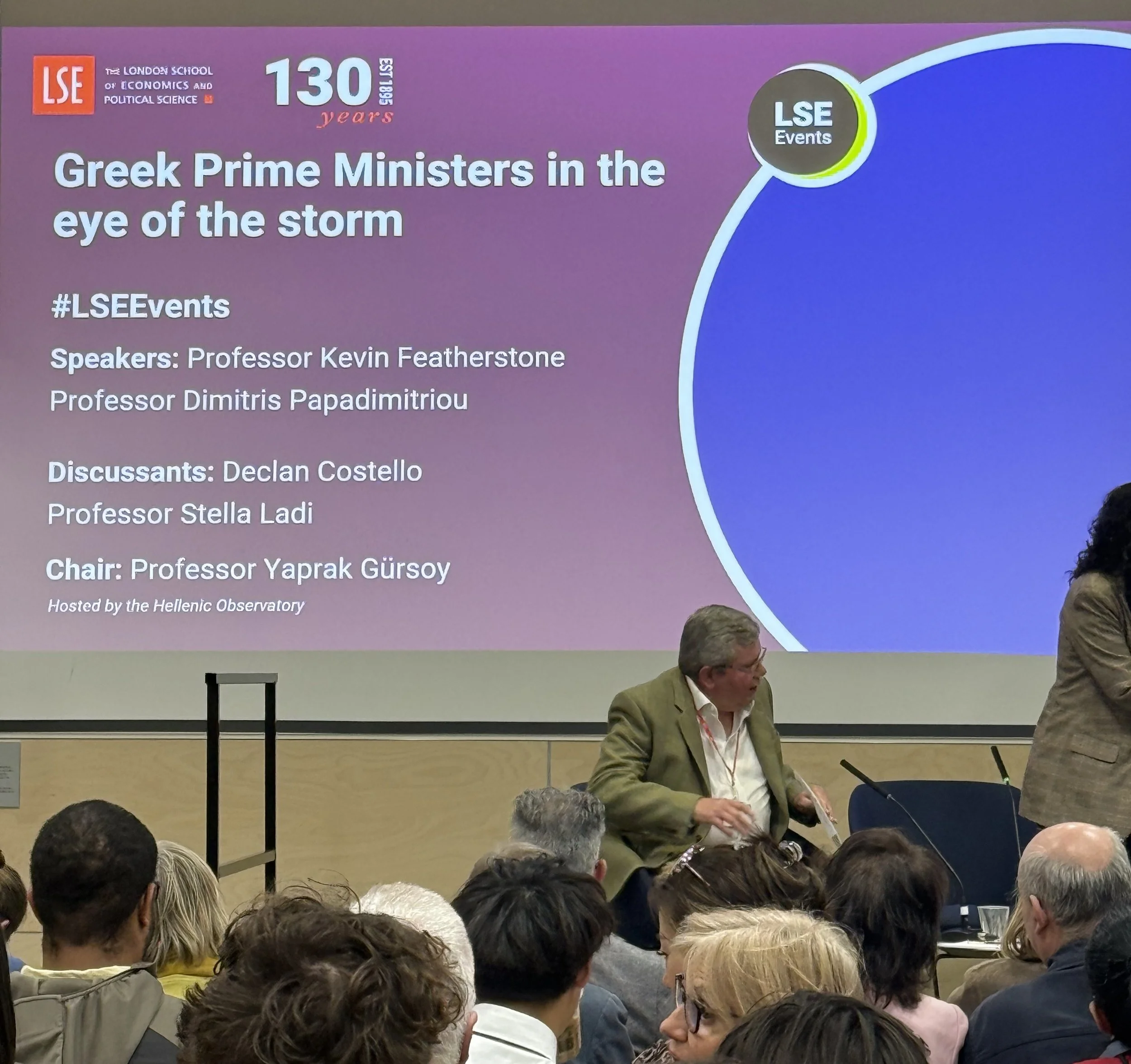
Conference at London School of Economics and Political Science
After the Congress in London School of Economics and Political Science, called “Greek Prime Ministers in the Eye of the Storm”, with Professor Kevin Featherstone, Professor Dimitris Papadimitriou and Professor Stella Ladi, I’ve thought and tried to start reshaping the scenario behind the Greek Crisis. In the late 2009, the economic crisis in Greece began to unfold, when the newly elected government revealed that the country’s budget deficit was far higher than previously reported, reaching about 15% of GDP. This announcement triggered a loss of confidence in financial markets, and by early 2010, Greece was unable to borrow money at sustainable interest rates. 1Hellenic Statistical Authority, Government Deficit and Debt Statistics, 2009–2010. 2European Central Bank, Financial Stability Review, 2010.
International Bailouts and Austerity Measures
In May 2010, Greece received its first international bailout from the European Union and the International Monetary Fund, marking the start of an extended period of austerity measures, including spending cuts and tax increases. A second bailout followed in 2012, alongside a major debt restructuring. Despite these efforts, the crisis deepened, leading to severe economic contraction, high unemployment, and widespread social unrest. The situation reached a peak in 2015, when political tensions rose and a national referendum rejected further austerity measures. However, later that year, Greece agreed to a third bailout program. The crisis officially ended in August 2018, when Greece exited its final bailout program8, although its economic and social effects continued for years afterward. Government Deficit Formula The core mechanism of government debt dynamics can be expressed as follows:
Debt *t = Debt *t −1 + Deficit *t
This simple relationship tells you: If a government runs a deficit (spends more than it collects in taxes), its debt increases. If this happens year after year, debt accumulates quickly. In Greece before 2009, persistent deficits meant debt kept rising, even during years of economic growth.
Why Did It Become a Crisis? (Adding Interest and Growth)
To really understand the explosion of the crisis, economists use a more complete version:
Δd = (r − g) d − p
Where: d = debt-to-GDP ratio
r = interest rate on debt
g = economic growth rate
p = primary surplus (or deficit if negative)
What Went Wrong in Greece?
This equation explains the crisis perfectly:
High deficits (p negative) → government kept borrowing
Low or negative growth (g ↓) after 2008 → economy shrank
Rising interest rates (r ↑) after markets lost trust in 2009
When r > g, debt grows automatically, even without new spending.
That is exactly what happened: After the 2008 global monetary crisis, Greece’s economy contracted. Investors demanded higher interest rates. Debt spiraled out of control. Greece entered the crisis with high deficits and rising debt. When growth collapsed and borrowing costs increased after 2009, the debt dynamics became unsustainable, forcing international bailouts.
Current Values and 2026 Projections
Using current values and 2026 projections:
The author, Oksana Alesi Koshla, considers the formula:
Δd = (g • p) : (r - d)
Example (Greece and the euro area):
g = Greece’s GDP growth (2026 projection): 1.8%
p = Greece’s inflation rate (2026 projection): 3.5%
r = Euro area unemployment rate (March 2026): 6.2%
d = Euro area GDP growth (Q1 2026): 0.1%
Calculation:
(1.8 • 3.5) : (6.2 – 0.1) = 6.3 : 6.1 ≈ 1.03
Result: approximately 1.03
This formula can be interpreted as an experimental macroeconomic indicator that captures the relative balance between domestic economic momentum (growth and inflation) and external macroeconomic constraints within a monetary union. Rather than representing a formal debt dynamics model, it provides a synthetic measure of alignment between internal and external economic conditions.
Interpretation
With these values, the product of Greece’s growth and inflation is nearly offset by the euro area denominator (r - d), yielding a ratio close to unity. Growth - Inflation Interaction Adjusted for Euro Area Macroeconomic Frictions. The result (≈ 1.03) suggests a near proportional relationship, rather than full equilibrium between Greece’s internal economic momentum and the external macroeconomic environment of the euro area. This suggests that, under current conditions, domestic growth and inflation dynamics are broadly aligned with the structural constraints imposed by the wider European context.
What can learn from this crisis Europe and Other Countries
What can Europe and other countries learn from Greece’s crisis?
The Greek debt crisis provides important lessons for Europe and other countries around the world, particularly regarding fiscal discipline, economic resilience, and institutional design. One of the key triggers of the crisis was the loss of market confidence after the government revealed in 2009 that its budget deficit had been significantly underreported. This highlights the critical importance of fiscal transparency, as unreliable data can quickly undermine trust, and lead to rising borrowing costs. In addition, Greece had run persistent budget deficits for many years, even during periods of economic growth, which caused public debt to accumulate steadily. This demonstrates that governments should use favourable economic conditions to strengthen public finances rather than increase vulnerabilities. The crisis also illustrates how quickly debt dynamics can become unsustainable when macroeconomic conditions deteriorate.
Following the 2008 global financial crisis, Greece experienced a sharp contraction in economic growth while interest rates on its debt increased significantly. When borrowing costs exceed growth, debt tends to rise automatically, making stabilization much more difficult. This underlines the importance of maintaining a balance between growth and interest rates and acting early when risks emerge. Furthermore, the crisis exposed structural weaknesses in the design of the Eurozone. As a member of a monetary union, Greece could not devalue its currency or conduct an independent monetary policy, limiting its ability to respond to the crisis and emphasizing the need for stronger fiscal coordination among member states. Another key lesson concerns the limits of austerity. The bailout programs led by the International Monetary Fund and European institutions imposed strict fiscal consolidation measures, including spending cuts and tax increases. While these policies helped stabilize public finances, they also led to deep economic recession, high unemployment, and significant social unrest. This suggests that fiscal adjustment policies must be carefully balanced with the need to support economic growth and social stability. Moreover, the Greek case shows that structural problems, such as low productivity, tax evasion, and inefficiencies in public administration, can significantly worsen the impact of a crisis. Addressing these underlying issues is essential for long-term economic resilience. The Greek crisis ultimately demonstrates that fiscal irresponsibility alone does not create a crisis, rather, crises emerge when weak institutions, structural inefficiencies, and external constraints interact under adverse economic conditions. For Europe and the global economy, the central lesson is clear: sustainable stability requires not only disciplined public finances, but also institutional credibility, coordinated policy frameworks, and the capacity to respond rapidly to shocks. Without these elements, even advanced economies remain vulnerable to systemic disruption. This raises the question of whether the institutional design of the Eurozone is structurally incomplete in the absence of fiscal union.
Conclusion
This paper proposes a simple, experimental indicator to interpret the relationship between national economic dynamics and external macroeconomic pressures. While not intended to replace established models, the indicator offers a synthetic and intuitive perspective that may support comparative analysis and further research.
— Oksana Alesi Koshla
Bibliography
1. Hellenic Statistical Authority, Greek Government Deficit and Debt Statistics, 2009–2010 (Athens: ELSTAT, 2010).
2. European Central Bank, Financial Stability Review (Frankfurt: ECB, 2010).
3. International Monetary Fund, Greece: Stand-By Arrangement (Washington, DC: IMF, 2010).
4. European Commission, The Second Economic Adjustment Programme for Greece (Brussels: European Commission, 2012).
5. World Bank, Greece Economic Monitor (Washington, DC: World Bank, 2013–2014).
6. European Stability Mechanism, Financial Assistance Programme for Greece (Luxembourg: ESM, 2015).
7. European Commission, Greece Exits Stability Support Programme (Brussels: European Commission, 2018).
8. Olivier Blanchard, Macroeconomics, 7th ed. (Boston: Pearson, 2017).
9. Carmen M. Reinhart and Kenneth S. Rogoff, This Time Is Different: Eight Centuries of Financial Folly (Princeton, NJ: Princeton University Press, 2009).
10. Olivier Blanchard, “Public Debt and Low Interest Rates,” American Economic Review 109, no. 4 (2019): 1197–1229.
11. International Monetary Fund, Staff Guidance Note for Public Debt Sustainability Analysis in Market-Access Countries (Washington, DC: IMF, 2013).
12. European Central Bank, Annual Report 2010 (Frankfurt: ECB, 2011); Hellenic Statistical Authority, Greek Government Deficit and Debt Statistics (Athens: ELSTAT, various years).
13. European Commission, Report on Greek Government Deficit and Debt Statistics (Brussels: European Commission, 2010).
14. International Monetary Fund, Greece: Staff Report on Request for Stand-By Arrangement (Washington, DC: IMF, 2010).
15. European Central Bank, The Euro Area Sovereign Debt Crisis (Frankfurt: ECB, 2012).
16. International Monetary Fund, Greece: Ex Post Evaluation of Exceptional Access under the 2010 Stand-By Arrangement (Washington, DC: IMF, 2013).
17. Mark Blyth, Austerity: The History of a Dangerous Idea (Oxford: Oxford University Press, 2013).
18. Barry Eichengreen, The European Economy since 1945: Coordinated Capitalism and Beyond (Princeton, NJ: Princeton University Press, 2007).